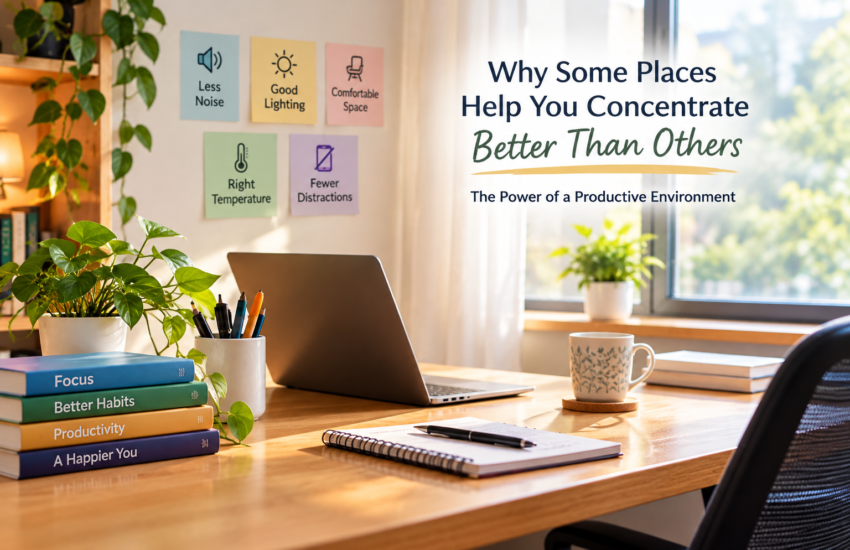
Introduction
Have you ever tried to study or complete a task in one place and found yourself constantly losing focus? Then you moved somewhere else and suddenly the same task felt easier.
The difference may not be your ability.
Sometimes, the environment around you affects how easily you can concentrate.
A busy room, repeated notifications, uncomfortable furniture, poor lighting, or people moving around can compete for your attention. On the other hand, a suitable environment can make it easier to stay with one task.
This does not mean there is one perfect place for everyone. Different people work well in different surroundings.
What matters is understanding which parts of your environment help or interrupt your attention.
Your Surroundings Send Your Brain Constant Information
A room may look quiet, but your brain is still receiving information from it.
You may notice:
- Sounds from outside
- People moving nearby
- Objects on the desk
- Messages appearing on a screen
- Changes in temperature
- Bright or dim lighting
- Conversations happening around you
You do not necessarily think about every one of these things consciously.
However, each new interruption can compete with the task you are trying to complete.
A productive environment reduces unnecessary competition for attention.
Noise Does Not Affect Everyone in the Same Way
Some people can work with background sound. Others find even a small conversation distracting.
The type of sound can matter too.
A constant, predictable sound may be easier to ignore than speech happening nearby. When you hear people talking, your attention may naturally shift toward what they are saying.
This is one reason a person might be able to read in a room with a steady background sound but struggle when two people nearby are having an interesting conversation.
There is no single noise level that works for everybody.
The useful question is:
Which sounds make it easier or harder for me to stay focused?
Light Can Change the Feel of a Workspace
Lighting is another part of the environment that people often overlook.
A space that is too dark may feel uncomfortable for reading or computer work. Very harsh lighting may also make a workspace unpleasant.
Natural daylight can make a room feel more open, while a suitable indoor light can help when daylight is unavailable.
The goal is not to create a special-looking workspace. It is to make the area comfortable enough that lighting does not become an unnecessary distraction.
Your Desk Can Influence What Your Attention Notices
A crowded desk contains many visual objects.
Books, papers, cables, food containers, devices, stationery, and unrelated items may all compete for attention.
This does not mean a messy desk automatically makes someone unproductive. People have different preferences.
However, if you repeatedly look at unrelated objects instead of your current task, reducing the number of visible distractions may help.
You do not need to clean everything.
Simply keeping the items related to your current task nearby can create a clearer visual space.
Comfort Matters, but Too Much Comfort Can Change Your Energy
A chair, desk, and screen position can affect how comfortable it feels to remain in one place.
If you are constantly adjusting your position because something feels uncomfortable, part of your attention is being pulled away from your work.
At the same time, an extremely relaxing environment may make some people feel ready to rest rather than concentrate.
This is why the best setup is often somewhere between discomfort and excessive relaxation.
The space should support the activity you are trying to do.
Temperature Can Become an Invisible Distraction
Temperature is easy to ignore until it becomes uncomfortable.
If a room feels unusually hot or cold, you may keep thinking about the temperature instead of your task.
Once the environment becomes more comfortable, that distraction may disappear into the background.
Small environmental factors can therefore matter even when they are not directly related to the work itself.
Your Phone Can Change the Attention Landscape
A phone does not have to ring to become distracting.
If it is sitting beside you and you are expecting a message, part of your attention may remain connected to it.
You may also notice the screen lighting up or feel tempted to check an application.
For tasks that require concentration, placing unnecessary devices farther away can reduce the number of possible interruptions.
This is not about avoiding technology completely. It is about deciding when technology should have your attention.
Familiar Places Can Create Useful Associations
A particular place can gradually become associated with a particular activity.
For example, if you regularly use one desk for studying, sitting there may eventually make it easier to shift into study mode.
This happens because routines connect activities with surrounding cues.
The same principle can work in other situations.
A certain chair may become associated with reading. A particular desk may become associated with computer work. Another area may be used mainly for relaxing.
The environment can therefore become part of a person’s routine.
Changing Location Can Sometimes Refresh Attention
Staying in the same place for a long time can become tiring.
Changing location may provide a small mental break.
For example, someone might read at a desk, move to another suitable place for a different task, and later return to the desk.
The change does not magically create concentration. It can simply break up a repetitive routine and provide a fresh starting point.
The important thing is that the new location should still support the task.
People Around You Can Affect Concentration
Other people are one of the most obvious sources of interruption.
A conversation, question, movement, or unexpected request can pull your attention away from what you are doing.
This is especially noticeable when the task requires careful reading, writing, problem-solving, or remembering information.
Sometimes complete isolation is not possible.
In that case, a person can make small adjustments, such as choosing a quieter corner or working during a less busy period.
There Is No Universal Productive Environment
A common mistake is assuming that everyone needs the same type of workspace.
One person may prefer complete silence.
Another may enjoy quiet background sound.
Someone else may concentrate better while sitting near a window.
Another person may prefer a simple desk away from windows and movement.
Productivity is influenced by personal preferences as well as the task being performed.
Instead of copying someone else’s setup, it makes more sense to observe your own response to different environments.
The Task Also Changes What Environment You Need
Not every activity requires the same surroundings.
Reading a simple article may be possible with some background noise.
Writing an important document may require more privacy.
Watching an educational video may require a clear screen and good sound.
Creative work may benefit from a different arrangement than detailed computer work.
The environment should therefore match the activity.
A flexible workspace can be more useful than a rigid one.
Try Changing One Thing at a Time
If your current workspace does not feel helpful, you do not need to change everything at once.
Test one small adjustment.
You could:
- Move your phone away
- Reduce unnecessary desk items
- Change the lighting
- Close an unused browser window
- Choose a quieter location
- Adjust your chair
- Work during a less busy time
Then notice whether the change makes the task easier.
Changing one factor at a time also helps you understand what actually affects your concentration.
A Productive Environment Is Really About Fewer Unnecessary Interruptions
A good workspace does not have to be expensive or professionally designed.
You do not need special furniture, decorative equipment, or a large room.
In many cases, a useful environment is simply a place where the things you need are available and unnecessary interruptions are limited.
A basic desk in a quiet corner can work perfectly well if it suits the person using it.
The purpose of the environment is to support the activity, not to look impressive.
Final Thoughts
Concentration is not only about willpower.
The place where you study, read, write, or work can influence how often your attention is interrupted. Noise, lighting, comfort, temperature, phones, people, and visual distractions can all become part of the experience.
There is no single formula for creating the perfect workspace.
Instead, pay attention to your own surroundings. Notice what repeatedly interrupts you and make small changes where possible.
A productive environment is not necessarily a perfect room. It is simply a place that makes it easier for you to give your attention to the task in front of you.