
In this guide, you will learn how to choose the right keywords for SEO without making your content sound unnatural.
Imagine that you have written a helpful article, but the people who need that information never find it. One reason can be that your content is not connected to the words people use when they search online.
This is why keyword selection matters in SEO.
A keyword gives you a starting point for understanding what your readers are looking for. It can also help you decide what your article should cover. But finding a keyword is not simply about picking a phrase with a large number of searches.
The better approach is to find a phrase that connects your topic, your audience, and their reason for searching.
Start With a Problem, Not a Keyword
Many beginners open a keyword research tool before deciding what they want to help their readers with. This can produce a long list of words, but a long list does not automatically give you a good article idea.
Start with a problem instead.
Suppose you want to write for people who are new to blogging. What might they struggle with?
They may not know:
- How to choose a blog topic
- How to find words people search for
- How to use keywords in an article
- Why some blog posts receive visitors while others do not
These problems can become the starting point for your research.
Once you understand the problem, you can look for the words people use when talking about it.
Think Like Your Reader
Website owners sometimes choose keywords based on what they want to promote. Readers, however, do not search according to your business plan. They search according to what they need.
For example, imagine you offer SEO writing services.
You might describe your service as:
SEO content services
But a person who is new to SEO might search:
How do I write an SEO blog post?
Both phrases are related to content and SEO, but they represent different needs.
Before selecting a keyword, imagine sitting in front of Google as your potential reader. What would you type if you had the same question?
This simple change in thinking can give you better keyword ideas.
Look at the Complete Search Phrase
Do not always focus on one word.
A single word can have many possible meanings. A longer phrase often gives you more information about what the searcher wants.
Compare these examples:
Blog
How to write a blog for beginners
The first phrase is extremely broad. The last one gives you a much clearer idea about the person’s goal.
This is why specific phrases can be useful when planning blog content. You can understand the expected topic more easily and create an article around a particular need.
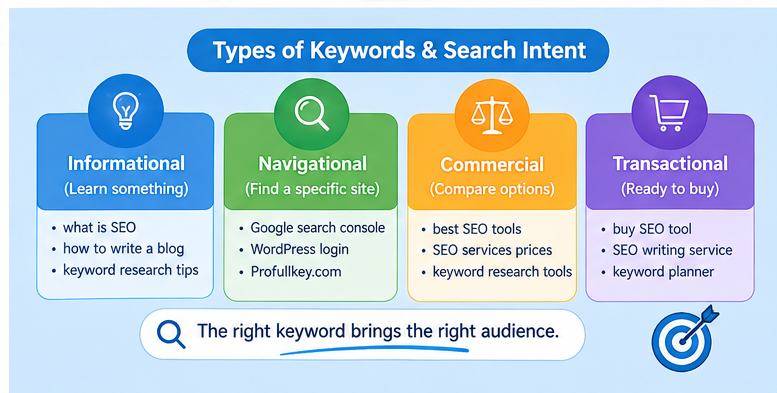
Separate Questions From Buying Searches
Not every search has the same purpose.
Some people are learning. Some are comparing options. Others already know what they want and are looking for a place to buy or sign up.
Consider these examples:
What is an SEO audit?
This sounds like a learning search.
Best SEO audit tools
This suggests that the person is comparing tools.
SEO audit service
This may indicate that the person is looking for a service.

If your article is designed to teach beginners, a keyword that represents a learning question may fit better than a keyword used mainly by people searching for a service.
Understanding this difference can prevent you from creating content that does not match the expectations of your visitors.
Build a Small Keyword List
You do not need hundreds of phrases for one blog post.
Start with a small group.
For an article about SEO keywords, your initial list might look like this:
- SEO keywords
- keyword research
- choosing SEO keywords
- finding keywords for a blog
- keyword ideas for beginners
- long-tail keywords
- search intent
Now look at the relationship between these phrases. Some can become part of the main article, while others may be better topics for separate posts.
This helps you avoid trying to cover everything on one page.
Check What People Are Actually Searching
Once you have some ideas, research them.
Search the phrase yourself and look at the type of results that appear. Pay attention to the questions, topics, and formats that are commonly shown.
For example, if most results for a phrase are detailed tutorials, that tells you something about what searchers may expect.
If the results are mostly product pages, writing a general educational article may not be the best match.
The search results can therefore give you clues about the type of content you should create.
Use Search Volume Carefully
Keyword tools often show search volume. This number can be useful, but it should not control your entire decision.
A keyword with a large search volume may sound attractive. However, if it is too broad or does not match your website, those searches may not bring the right audience.
A smaller, highly relevant phrase can make more sense for a specific article.
For example, a website teaching beginners might prefer a focused topic such as SEO keyword research for beginners rather than trying to build an entire article around the very broad term SEO.
The question is not simply:
“How many people search this?”
You should also ask:
“Are these the people I want to reach?”
Look at Competition, But Don’t Obsess Over It
Some keyword tools provide competition or difficulty scores. These can help you compare different opportunities.
However, these scores are estimates. They are not promises about what will happen to your page.
A keyword may have a low difficulty score but still be a poor choice if it does not fit your content. Likewise, a useful topic should not automatically be rejected just because another website covers it.
Use competition data as one piece of research rather than the final decision.
Select a Main Phrase
After researching your ideas, choose one phrase that describes the central purpose of your article.
For this article, the focus phrase is:
how to choose the right keywords for SEO
Everything in the article should support that subject.
You can still use related terms such as keyword research, search intent, search volume, and long-tail keywords. They help explain the subject without requiring you to repeat the exact focus phrase again and again.
Place the Keyword Where It Makes Sense
Once you have selected your main phrase, you can include it in important areas of the page.
For example:
- Page title
- Main heading
- Opening paragraph
- Relevant sections
- URL
- Meta description
But do not treat these locations as boxes that must all contain the exact same phrase.
Your wording should remain natural.
If a sentence becomes awkward because you are trying to insert a keyword, rewrite the sentence. A clear sentence is more useful to your reader than a forced keyword placement.
Related Words Can Strengthen the Topic
Good content usually talks about a subject using more than one expression.
If you are writing about choosing keywords, you might naturally discuss:
- search terms
- search intent
- keyword research
- related queries
- content topics
- long-tail phrases
These terms help you explain the subject from different angles.
You do not need to create a separate paragraph simply to include each word. Mention them when they genuinely contribute to the explanation.
Keep the Reader in Control
One of the easiest ways to damage an otherwise good article is to write for a keyword instead of a person.
Read your finished article from the reader’s point of view.
Does each section answer something useful?
Is the explanation easy to follow?
Would a beginner understand the examples?
Can the reader take something practical from the article?
If the answer is yes, your keyword is doing its proper job: helping you organize useful content rather than controlling every sentence.
Mistakes to Avoid
Picking a Keyword Only Because It Is Popular
Popularity does not automatically make a phrase suitable for your website.
Choosing a Phrase That Your Article Does Not Answer
If the searcher expects one type of information but your article provides something completely different, the keyword and content are mismatched.
Using Too Many Main Keywords
Trying to make one article about five different subjects can weaken its focus. Give the page one clear central purpose.
Repeating the Exact Phrase Everywhere
Your readers should not feel like they are reading the same sentence repeatedly. Use natural language.
Forgetting Your Website’s Audience
A keyword can look attractive in a research tool but still be unsuitable for the people you want to reach.
A Simple Keyword Selection Process
If you are new to SEO, you can follow this basic process:
Step 1: Choose a topic you can explain well.
Step 2: Think about the problem your reader wants to solve.
Step 3: Write down the phrases they might search.
Step 4: Research those phrases and examine the search results.
Step 5: Compare relevance, search intent, search volume, and competition.
Step 6: Select one main phrase for your article.
Step 7: Create useful content around that phrase.
Step 8: Review the article and remove unnatural keyword repetitions.
This process keeps keyword research practical instead of complicated.
Final Thoughts
Choosing a keyword is really about understanding the connection between a searcher and your content. The best keyword for an article is not necessarily the one with the biggest number beside it in a keyword tool.
Start with your audience. Find out what they need, understand the purpose behind their search, and then select a phrase that represents that need.
After that, create an article that genuinely helps them.
When the keyword and the content have a natural connection, you have a much better foundation for building useful SEO content.