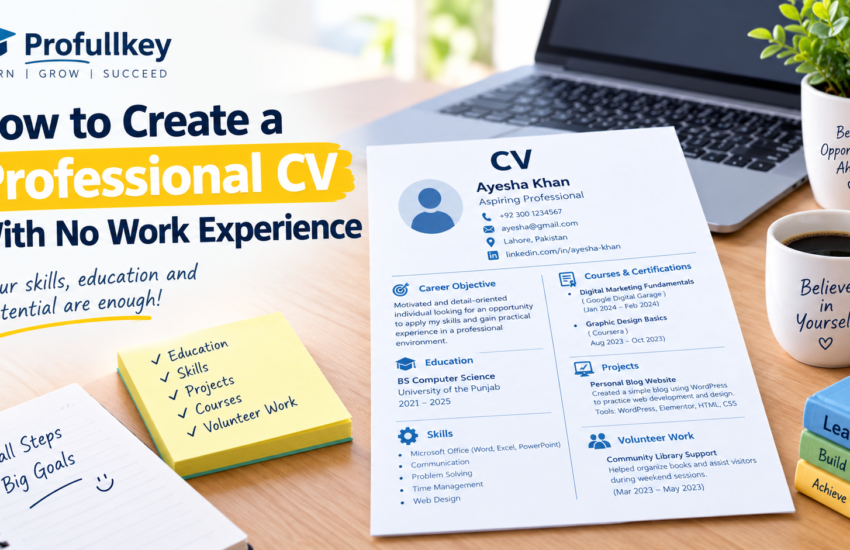
Introduction
Writing your first CV can be confusing, especially when you have never worked for a company before. You may feel that there is not enough information to put on the page. In reality, a person can have useful knowledge and abilities without having a long employment history.
Your education, training, personal projects, volunteer activities, computer skills, and other experiences can tell an employer something about your abilities. The challenge is deciding what deserves a place on the CV and presenting it in a clear way.
A beginner CV does not need to look like the CV of someone with ten years of experience. It simply needs to give the reader a realistic picture of your background and the type of work you are prepared to do.
What Should a Beginner Put on a CV?
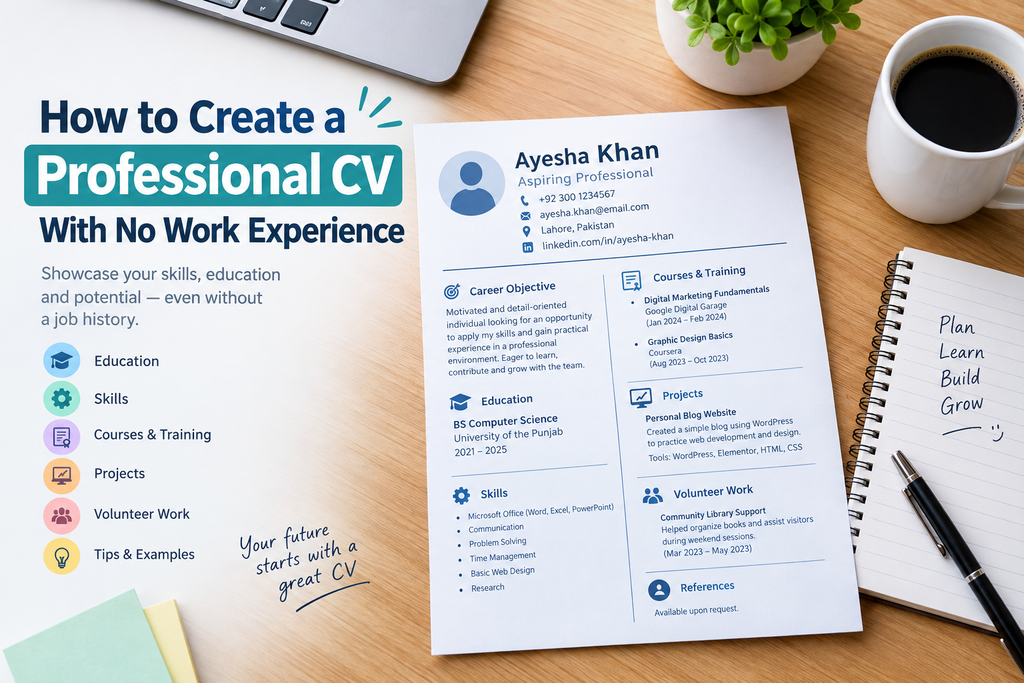
A CV normally brings several pieces of information together in one document. For someone without previous employment, the most useful sections may include:
- Contact information
- A short personal or career introduction
- Education
- Relevant skills
- Courses and training
- Personal or academic projects
- Volunteer activities
- Achievements, where relevant
You do not have to use every possible section. Choose the ones that provide useful information about your background.
For example, a student may have more education and academic projects to discuss, while someone who has completed several online courses may want to give more space to training and practical work.
Begin With Your Name and Contact Details
The upper part of your CV should tell the reader who you are and how they can contact you.
Your name should be easy to notice. Under it, you can provide details such as your phone number, professional email address, and general location.
If you have a LinkedIn profile or an online portfolio that is relevant to the position, you may include it as well.
Check these details before sending your CV. An incorrect phone number or email address can create an unnecessary problem if an employer wants to contact you.
It is also better to use an email address that looks appropriate for professional communication.
Add a Short Introduction
A short introduction can be useful when you have limited work history. Instead of focusing on what you do not have, use this space to explain your current background and the type of opportunity you are looking for.
Keep the paragraph specific.
For example, a recent graduate interested in administrative work could mention their education, computer knowledge, organization skills, and interest in developing experience in an office environment.
Avoid making claims that you cannot support. Your introduction should describe your real abilities rather than trying to sound more experienced than you are.
Present Your Education Clearly
For many beginners, education will be one of the strongest sections of the CV.
Start with your latest qualification and work backward if you have several qualifications. You can mention the institution, program or subject, and completion year where appropriate.
You might also include an academic project when it relates directly to the position.
For example, a student applying for a writing-related opportunity could mention a research assignment or major writing project that demonstrates their ability to gather information and communicate ideas.
There is no need to turn this section into a complete history of everything you studied. Give more attention to information that has a connection with the opportunity.
Choose Skills That Match the Job
A CV becomes more useful when the skills listed on it relate to the position.
Instead of adding a very long collection of abilities, think about what you can genuinely do.
Depending on your background, your skills might include:
- Microsoft Word
- Basic Excel
- Written communication
- Research
- Customer communication
- Time organization
- Canva
- WordPress
- Data entry
- Translation
- Content writing
Only include skills that you can explain or demonstrate if an employer asks about them.
It is also helpful to separate practical or technical abilities from general strengths when the CV layout allows it.
Include Courses and Training
Courses can add useful information to a beginner CV, particularly when they are related to the position.
Suppose you are applying for a digital marketing role and have completed an introductory digital marketing course. Mentioning that training can show that you have taken steps to learn the subject.
For each useful course, you can provide the course title and the organization or platform where you completed it.
If you are currently taking a course, describe it as ongoing rather than presenting it as completed.
Honesty matters here. Do not add certificates or qualifications simply because they make the CV look stronger.
Use Personal Projects to Show Your Ability
Personal projects are particularly useful for people who have little or no employment history.
A project gives you an opportunity to show how you have applied something you learned.
For example, someone interested in website development might create a small practice website. A beginner writer could prepare several original articles. A person learning graphic design could build a collection of sample designs.
When describing a project, explain what you created, what your role was, and which tools or skills you used.
This gives an employer a better idea of what you can actually do.
Volunteer Work Can Also Be Relevant
Unpaid activities can sometimes provide useful evidence of responsibility and practical experience.
If you have helped an organization, school, community group, event, or educational activity, consider whether that experience relates to the position.
Rather than writing only “Volunteer,” describe your actual responsibilities.
For instance, if you helped organize an event, you might have handled registration, communicated with participants, prepared documents, or arranged materials.
The value comes from explaining what you actually did.
Keep the Layout Clean
Your CV does not need a complicated design.
A clean page with readable text, clear headings, and sensible spacing can make the information easier to follow. Use a consistent style throughout the document.
Avoid filling the page with large graphics, unnecessary decorations, or too many different fonts.
Before submitting the CV, save it in the format requested by the employer. If no specific format is given, a PDF is often useful because it can preserve the appearance of the document across devices.
Open the final file yourself and check it before sending it.
Adjust Your CV for the Position
A CV should reflect the opportunity you are applying for.
Read the vacancy carefully and identify the main responsibilities and requirements. Then look at your own background and decide which genuine qualifications or abilities are most relevant.
For example, imagine two positions:
- One requires basic computer and administrative skills.
- Another focuses on writing and research.
You might use the same basic CV for both, but the information given greater attention should be different.
This does not mean changing your experience or adding things you have never done. It means organizing your real background according to the position.
What If You Have No Experience at All?
If you have no formal work experience, do not create imaginary employment just to make your CV look complete.
Instead, think about activities that helped you develop useful abilities.
You may have:
- Completed academic assignments
- Created personal projects
- Taken online courses
- Helped with a family business
- Participated in school or community activities
- Managed a small personal project
- Practiced a professional skill independently
Not every activity belongs on a CV. Choose examples that have a reasonable connection with the type of work you want.
Common Problems to Avoid
Making the CV Too Long
A beginner does not need several pages filled with unrelated information. Remove details that do not contribute anything useful.
Using the Same CV for Every Application
Sending an identical CV everywhere can make your application less relevant. Make reasonable adjustments when a position has specific requirements.
Adding Skills You Cannot Use
A long skills list may look impressive at first, but it can create problems if you cannot answer basic questions about those skills.
Copying Someone Else’s CV
You can look at CV examples to understand formatting, but the content should represent your own background.
Ignoring Errors
Typos, incorrect dates, broken formatting, or outdated contact information can make a CV look unfinished.
Adding False Information
Never invent employment, certificates, grades, or achievements. A CV should be an accurate description of your background.
Final Check Before Sending Your CV
Take a few minutes to review the document before submitting it.
Check your:
- Name
- Phone number
- Email address
- Education details
- Course information
- Skills
- Project descriptions
- Dates
- Spelling
- Formatting
Then read the CV from the employer’s point of view. Ask yourself whether the document makes it clear what you can do and what type of opportunity you are seeking.
Final Thoughts
Creating a CV without work experience is completely possible. Your first CV does not need to compete with the experience of someone who has already spent years in a profession.
Instead, use the document to present the strongest parts of your current background. Education, relevant skills, training, projects, and meaningful activities can all help explain what you have learned and what you are capable of doing.
Keep the information truthful, remove unnecessary details, and make the document easy to read. As you gain experience, you can update the same CV with new responsibilities, projects, qualifications, and achievements.
Your first CV is not the final version of your professional story. It is simply the starting point.
Way better than what I was using before, dream catcher game strategy actually has depth to it and keeps things intresting instead of being super repetitive. The gameplay is smoother and the whole thing just feels more polished tbh, glad I made the switch.