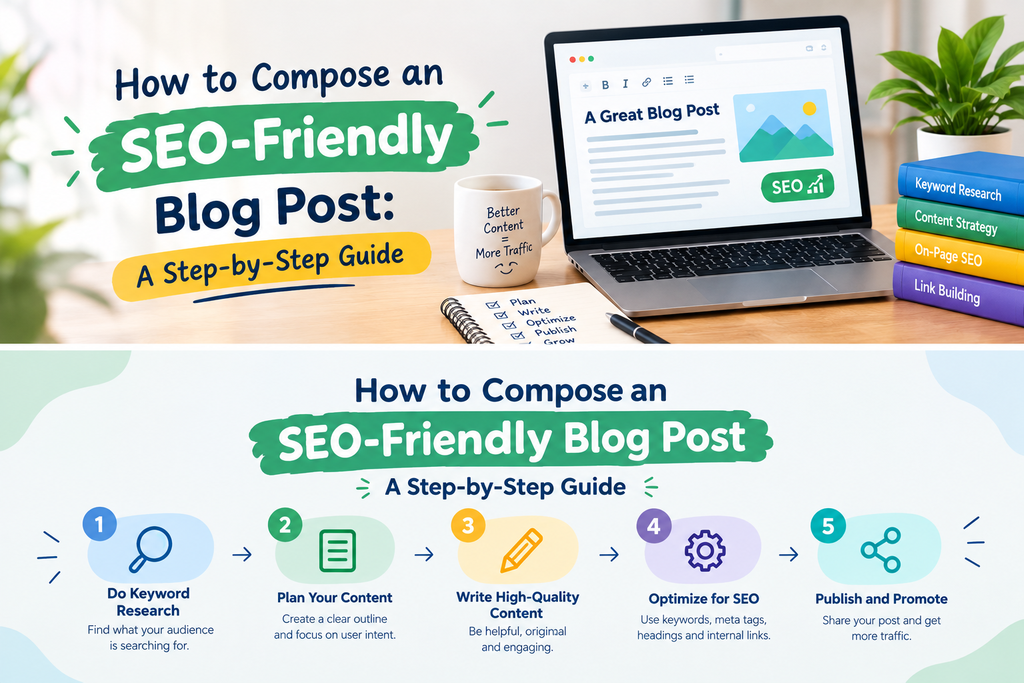
How to compose an SEO-friendly blog post
Writing a blog post is not only about putting words on a page. A noble blog post must be beneficial for students, informal to realize, and enhanced for examine instruments. When you compose an SEO-friendly blog post, you help search engines understand your content and give your article a better opportunity to appear in search results.
In this guide, you will learn how to compose an SEO-friendly blog post step by step, from understanding search intent and choosing keywords to writing useful content, using headings, adding internal links, and optimizing your post for readers and search engines.
What Is an SEO-Friendly Blog Post?
An SEO-friendly blog post is an article that is written to provide useful information to readers while also following basic search engine optimization practices.
A good SEO-friendly blog post should:
- Provide helpful and relevant information
- Be easy to read and understand
- Answer the reader’s question
- Match the user’s search intent
- Use relevant keywords naturally
- Have clear headings and subheadings
- Be easy to read on mobile devices
- Load quickly and provide a good user experience
1. Understand Search Intent
Already text an editorial, you should comprehend exploration resolved. Search intent means what a user wants to find when they type a query into Google or another search engine.
For example, someone searching for “what is SEO” probably wants a simple explanation of SEO. Someone searching for “how to write an SEO-friendly blog post” wants practical steps and guidance.
If your article does not answer the actual question behind the search, it may not be useful to the reader.
Before writing, ask yourself:
- What is the user looking for?
- What question do they want answered?
- What information would be most helpful?
- What type of content would satisfy their search?
2. Choose the Right Keyword
Keywords are words or phrases that people type into search engines. Choosing a relevant keyword is an important part of writing an SEO-friendly blog post.
You can also use related keywords naturally throughout your article, such as:
- SEO blog writing
- SEO-friendly content
- how to write SEO content
- blog post SEO
- search engine optimization
Do not attempt to custom the keyword in all judgment. Keyword insulation can mark your satisfied testing to recite. In its place, use your chief keyword logically where it marks intelligence.
3. Create a Clear and Helpful Title
Your heading is one of the first possessions manipulators realize in examination consequences. A clear heading expresses students what your editorial is around and emboldens them to click.
For example:
How to Mark an SEO-Friendly Blog Support: A Step-by-Step Monitor
This title clearly explains the topic and tells readers that the article contains practical steps.
Try to keep your title simple, descriptive, and relevant to the content. Avoid creating a misleading title just to get clicks.
4. Write a Strong Introduction
The summary should rapidly expound what the editorial is around and why the student should endure reading.
A good introduction should:
- Introduce the topic
- Explain the value of the article
- Naturally include the main keyword
- Tell readers what they can learn
Avoid making the introduction unnecessarily long. Get to the main point and show readers how the article can help them.
5. Use Headings and Subheadings
Headings make your article easier to read.
Use an H1 heading for the main title and organize the article with H2 and H3 headings where suitable.
For example:
H1: How to Mark an SEO-Friendly Blog Boundary marker
H2: What Is an SEO-Friendly Blog Post?
H2: Understand Search Intent
H2: Choose the Right Keyword
H2: Create a Clear and Helpful Title
A well-organized article allows readers to quickly find the information they need.
6. Create Useful and Original Content
Do not write an article only to reach a certain word count. Instead, focus on answering the reader’s questions completely.
Before publishing, check whether your article:
- Answers the main question
- Provides accurate information
- Is easy to understand
- Adds useful details
- Avoids unnecessary repetition
- Provides something valuable to the reader
7. Use Keywords Naturally
Once you have selected your main keyword, use it naturally in important areas of your article.
You may use the keyword in:
- The title
- Introduction
- Main headings when relevant
- Body content
- URL
- Meta description
- Image alt text when appropriate
Always write for people first.
For example, instead of repeating “SEO-friendly blog post” many times, you can naturally use related phrases such as “SEO content,” “optimized blog article,” and “search-friendly content.”
8. Add Internal and External Links
Links can make your content more useful.
Center associates link your thing to other related sheets or blog posts on your own website. For example, an article about SEO-friendly blog posts could link to another article about “What Is SEO?”
External links can argument students to responsible websites or foundations when supplementary material is beneficial.
Links should be relevant and helpful. Sidestep addition links only to increase the number of links on a page.
9. Optimize Images
Images can make a blog post more attractive and easier to understand, but large or poorly optimized images can slow down your website.
Before uploading an image:
- Use a relevant image
- Reduce unnecessary file size
- Give the image a descriptive file name
- Add useful alt text
- Make sure the image works well on mobile devices
For example, instead of naming an image “IMG1234.jpg,” you could use a descriptive name such as “seo-friendly-blog-post.jpg.”
Alt text should describe the image clearly and should not be filled with unnecessary keywords.
10. Make Your Article Easy to Read
People usually do not want to read large blocks of text online. Make your article comfortable to read by using:
- Short paragraphs
- Clear headings
- Bullet points
- Simple language
- Helpful examples
- Enough spacing
You should also avoid unnecessary complicated words when a simple word can explain the same idea.
An easy-to-read article can provide a better experience for visitors.
11. Make Your Blog Post Mobile-Friendly
Many people use smartphones to search for information online. Your blog post should therefore work properly on mobile devices.
Check that:
- Text is easy to read
- Images fit the screen
- Buttons and links are easy to use
- Paragraphs are not too wide
- The page does not have unnecessary elements
A mobile-friendly website helps visitors access your content comfortably.
12. Write a Useful Meta Description
A meta description gives searchers a short summary of what your page is about. It can help users understand what they will find when they visit your article.
Write a clear and relevant description that naturally explains the topic. Avoid stuffing it with keywords.
For example, for an article about SEO-friendly blog posts, the description could explain that the guide teaches readers how to choose keywords, understand search intent, structure content, and optimize blog posts.
13. Review Your Article Before Publishing
Before publishing your blog post, take a few minutes to review it.
Check:
- Is the article answering the searcher’s question?
- Is the main keyword relevant?
- Is the keyword used naturally?
- Are the headings clear?
- Are there spelling or grammar mistakes?
- Are the links working?
- Are the images optimized?
- Is the article easy to read on mobile?
- Does the content provide real value?
A final review can help you find problems that you may have missed while writing.
Common Mistakes to Avoid
When writing an SEO-friendly blog post, avoid common mistakes such as keyword stuffing, copying content from other websites, using misleading titles, writing only for search engines, and adding unnecessary information just to increase the word count.
Another common mistake is forgetting the reader. SEO is important, but your content should always be useful to the people who visit your website.
Conclusion
Writing an SEO-friendly blog post is about combining useful information with basic SEO practices. Start by understanding search intent and choosing a relevant keyword. Then create a clear title, write helpful content, organize it with headings, use keywords naturally, add relevant links, optimize images, and make the article easy to read on all devices.
Remember, SEO is not only about ranking in search engines. It is also about helping the right people find useful answers. When you consistently create helpful, original, and well-structured content, you can build a stronger website and improve your chances of attracting organic traffic over time.